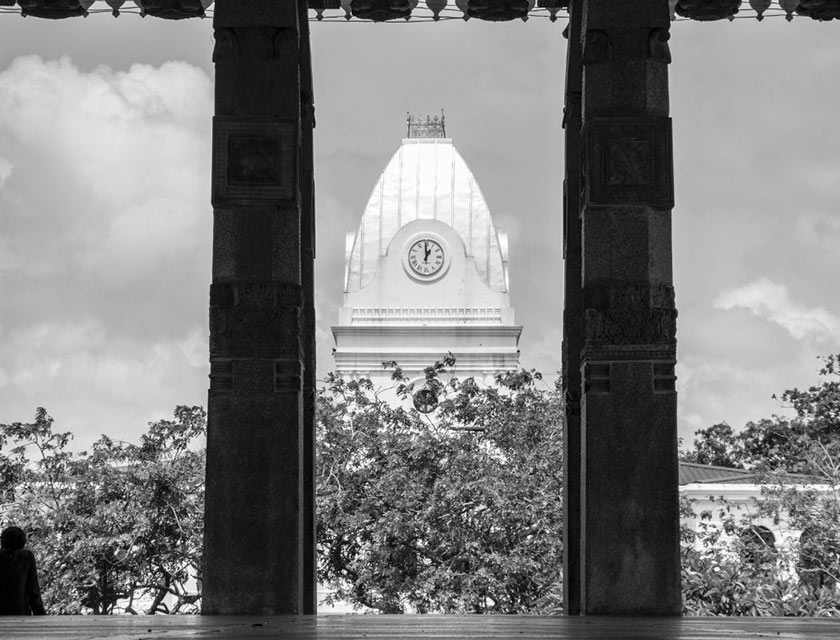
There is an aroma of history in the air in Kandy, although the city is not as steeped in antiquity as the cities of Anuradhapura and Polonnaruwa. Kandy became a capital only in the fourteenth century and that, in a country with a recorded history that goes back to the sixth century before Christ, is pretty modern.
Kandy was the cockpit of Lanka in the seventeenth and eighteenth centuries. It was captured thrice by the Portuguese, who ruled the maritime areas of the Island from 1505 to 1656, and once by the Dutch, who replaced the Portuguese and held sway from 1656 to 1796. On every occasion the foreign occupation of Kandy was brief. Remnants of the Portuguese forays can be seen, however, in the elements of European architecture in the palace of the Kandyan king. These are attributed to the employment of Portuguese prisoners-of-war. Kandy finally succumbed to the British in 1815.
To the Buddhists of Lanka and to the people generally, Kandy is the home of the Temple of the Tooth. The octagonal-shaped Dalada Maligawa, is a national palladium for it houses the Tooth Relic of the Buddha, an object of veneration to Buddhists all over the world. According to tradition the tooth was rescued from the flames at the cremation of Gautama Buddha at Kusinara in India in 543 BC. It was brought to the Island in the fourth century A.D.
Every morning drummers at the Temple of the Tooth beat a tattoo to signify a stage in a ritual that has been followed from time immemorial. As the drums reverberate streams of pilgrims, mostly clad in white, flow into the temple. Even to those unacquainted with the rituals the scene that presents itself is one of colour and fragrance. The devotees bring pink lotus blossoms and white frangipani while the perfume of joss sticks fills the air. The Tooth Relic reposes in a container or casket known as a Karanduwa, which is placed on a silver table. The relic is not on view except on special occasions.
The casket is borne on an elephant during the annual pageant known as the Kandy Esala Perahera conducted in the lunar month of Esala, according to the Buddhist calendar (usually late July or early August). The Kandy Perahera enjoys worldwide fame as one of the greatest of pageants. Only those who have seen it realize that it is an experience which words fail to convey. There are elephants majestic in appearance and caparisoned with clothes of gold and trappings which make them look like gigantic jewels on the move. There are richly dressed dancers who seem to defy the laws of motion. There are drummers whose resonant throbbing rises above the tinkling feet of the dancers, the sounds of the conch shells and the crashing of brass cymbals. There are Nilames (custodians) of the davales attired in glorious garb like those worn by their ancestors. There is the fragrance of flowers and joss sticks. It is a gorgeous spectacle, which as it moves along the streets makes the crowds packed to capacity gasp, some in wonderment and others in awe. The devout raise their voices in invocation and homage.
(text from "Handbook for the Ceylon Traveller", published by Studio Times, Colombo)
Norwood | Summerville | Castlereagh | Tientsin
Features
Tea Experience | Butler Service | Cuisine | Interiors | Gardens
Activities
Mountain Biking & Hiking | Heritage Quest
Excursions
Kandy | Adams Peak | Nuwara Eliya | Horton Plains | Udawalawe
Tea Trails
Contact Us | Book Now | Rates | Tea Trails Press | Terms and Conditions
Downloads
Logo | Directions | Fact Sheet | FAQ's | Activities | Brochure
- Traveler Reviews for Ceylon Tea Trails